

Content Wellbeing Notes: suicide. Please read with care if this content may be sensitive for you.
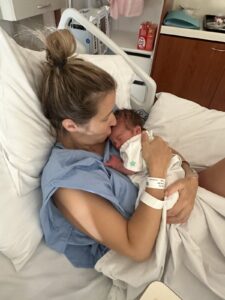
Marija Zivic serves as a non executive director on the Birth Trauma Australia Board. She is a media and communications specialist, and former senior political correspondent in the Canberra press gallery.
Marija is deeply committed to birth trauma advocacy at the highest levels following her own personal experience. The traumatic birth of her first child via forceps delivery in 2019 spurred Marija to reach out to Birth Trauma Australia and its founder Amy Dawes on a number of occasions, but a slow postpartum recovery meant it took some time to feel ready to help other women going through a similar experience.
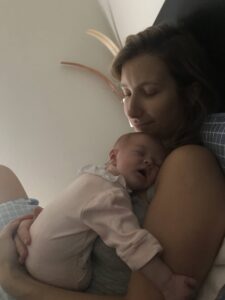
After the birth of her second child in 2025, Marija finally felt she had the strength to advocate for others. She hasn’t looked back since.
Marija’s Personal Journey
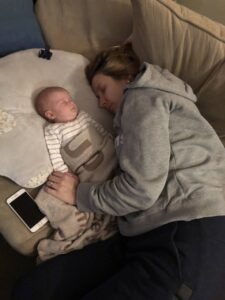
Marija has two children with a six-year age gap after experiencing birth trauma when her eldest was born through an emergency forceps delivery without pain relief in 2019. Her firsthand experience has ignited a deep passion to ensure that mothers, partners and families are not left feeling alone after experiencing birth trauma.
She is personally invested in continuing to build an organisation that gives birth trauma survivors hope, a voice and a community they can rely on when they need it. Beyond the prevention of birth trauma, she is leveraging her political knowledge to advocate for changes across the health system to better support mothers who experience birth trauma and ensure more medical professionals receive training about trauma-informed clinical practices.
In Marija’s Words
“A birth trauma survivor can look so desperately sad when she holds a newborn. While she’s privileged to be a mother, shadows block those early days and precious baby smells. Ugly thoughts remain. Unrelenting mental self-harm mixed with mother’s guilt.”
– Marija Zivic, Birth Trauma Australia board director
Marija writes about her personal experience in the following opinion piece, first published in The New Daily and InDaily here.
“Wow.” My new doctor reacts to the birth summary in front of him.
Maternal exhaustion. Unsuccessful ventouse. Forceps. Postpartum haemorrhage. Epidural, none.
Of course, there is so much the brief medical description doesn’t say.
Unforgettable, searing, pass-out pain. Inability to walk properly for weeks. Fainting in the shower from the blood loss. A woman, broken.
It doesn’t cover the colours of “that day”. Grey, for the 40-centimetre steel tongs used to drag my daughter out. Black, for the bruising all over my perineum that took months to heal. Red, for the blood splattered across the birthing suite floor. And pink, for the angry marks across my little girl’s face.
It doesn’t cover the way I felt “that day”. No longer human. Unable to stop the things happening to me, and being put inside me. Zero control.
This is birth trauma.
Others may not see it, but its face is recognisable.
Sometimes it’s the mother whose throat chokes up when everyone sings her child Happy Birthday. For her, it’s another reminder of the hardest moment of her life.
It’s visible in a large age gap between siblings. “You waited a while”, friends will say.
A birth trauma survivor can look so desperately sad when she holds a newborn. While she’s privileged to be a mother, shadows block those early days and precious baby smells. Ugly thoughts remain. Unrelenting mental self-harm mixed with mother’s guilt.
- Why can’t I just get over it?
- What’s wrong with me?
- Why am I still crying?
The physical injuries of a traumatic labour can take years to heal or become a lifelong burden. Pain, prolapse and bladder damage ensure that the trauma lives on, long after childbirth.
As a birth trauma survivor manages it all, she feels so alone. But the numbers prove she’s not.
One in three women experience birth trauma in Australia. That’s more than the number affected by domestic violence, endometriosis or breast cancer. Yet the lifelong health and economic impacts of birth trauma are nowhere near as widely recognised by government, medical professionals or the broader community. It is a silent epidemic affecting up to 100,000 women every year.
A recent report released by Birth Trauma Australia shows that the total economic impact of birth injuries and ongoing conditions is $17.5 billion in one year alone. Sadly, that is a conservative estimate and the true costs are likely far higher.
With a baby’s arrival, the focus shifts from mother to child. Everyone seemingly moves on. But for a birth trauma survivor, a new reality sets in.
Flashbacks. Nightmares. Crippling anxiety. Doctor distrust. Husband hatred. Frayed relationships. Incontinence and adult nappies. No more running, jumping or living … at least not like she used to.
It is identity theft at its worst, impacting her financially, emotionally and physically.
The path to recovery is steep. It means reliving “that day” every time someone pokes and prods around ground zero for her unhealed trauma. It takes time. Time that many women don’t have as the biological clock ticks. And expenses that not everyone can afford.
“It’s not normal, and it’s clearly impacting your quality of life.”
Recognition. More than two years after my first birth, I receive a diagnosis from my pelvic health physiotherapist. A first step to healing.
I didn’t know it then, but the delay to diagnosis put me at far greater risk of the leading cause of maternal death in Australia. Suicide.
Birth Trauma Australia data shows that among women who have suffered birth trauma and are diagnosed more than a year after birth, almost 60 per cent report having suicidal thoughts.
The calendar clicks over. I spend thousands of dollars and hundreds of hours trying to rehabilitate my body and my mind.
Just as the shadows start to clear ever so slightly, my daughter asks an innocent question: “Mama, why don’t I have a brother or sister?”
Paralysis. Fear. Tight throat. Tears. I unravel.
My mini-me looks up, and I once again feel so deeply broken. My darling girl, I don’t know if I can. We only just survived, together.
Ten steps back. Sleepless nights. Panic attacks. 3am. I can’t. I’m too scared.
What if I die this time?
The years pass.
Trauma so often leaves parents with no other choice than to be “one and done”. For years, I am incapable of contemplating another baby.
But my daughter persists: “Don’t worry mama, I’ll help you.”
I look at her, and I know there is a missing piece of our family puzzle. I’m desperate to find it.
My husband doesn’t dare bring it up. He too can’t erase the memories of mediaeval-like suffering. He’s never felt helplessness on that scale, watching the first love of his life and the second wrestle with death in the delivery room.
His eyes are instantly glassy when we reflect on “that day”, and I realise that my trauma has become his own. But we don’t want to live with regret, so we bury our fear and try for another baby.
First, a miscarriage. I’m bowled over with emotions as I mourn the baby that could have been. It was so incredibly hard to get to this point. It seems cruel.
I’m confused. There’s heartache, pain, and then a tinge of something else.
Relief.
I know it is trauma casting an evil spell, but it makes me physically sick.
As my body expels the baby that could have been, I’m hit with a sharp realisation. I really want this. I always have.
Another positive pregnancy test. Almost six years after “that day”, and we are having another baby.
Trauma plays its games again. This time, insomnia and panic are its favourite weapons. The shadows reappear. I consider a general anaesthetic for my upcoming birth, to numb the fear.
I tell myself it’ll be different this time. It has to be. It can’t be worse, can it?
Months later, I sit in the waiting bay ahead of my planned C-section. I’ve decided I’m going to do this fully awake. I don’t want to miss the moment, my redo and my chance to heal.
As I wait, cold, undiluted fear washes over me. My body is reacting. Zero control once again, this time of my bladder. I’m frozen except for the steady stream involuntarily leaving my body.
My name is called, and I’m wheeled into the bright lights of the operating theatre.
The anaesthetist puts a needle in my back. The “hard part” is over, I tell myself. As I lose all feeling in the lower half of my body, I exhale and give myself over to the team around me.
It’s the simplest, yet hardest thing to do.
Within 15 minutes, I meet my baby boy. I look into his eyes, and I’m completely overcome by it all. The relief is so visceral, I feel it in every part of my being as my body relaxes into an euphoric state.
I’ve carried so much pain and suffering for so long. Now I feel it floating away.
I turn my head and look at my husband. His face mirrors mine. Where there were once deep wounds, there are now light scars.
We are healing.
“Wow.”