

April’s Story
The birth of my son should have been one of the happiest moments of my life. Instead, I remember sobbing, overwhelmed by what had happened to my body and struggling to understand how something I had looked forward to so much had ended this way.
The pregnancy had been uncertain from the beginning. I contracted chickenpox at six weeks pregnant, and nobody could give us a definitive answer about what it might mean for our baby. We continued with the pregnancy, carrying that uncertainty with us.
My due date came and went. I was exhausted, emotional and desperate to meet my baby, so we agreed to an induction.
Because of the timing, it began on Christmas Eve.
They first tried tape to ripen my cervix. When that failed, a balloon catheter was inserted on Christmas Day to manually open it. I found the procedure excruciating. I was sent home that afternoon with the catheter still in place and spent Christmas night uncomfortable, frightened and in pain.
Early on Boxing Day, we returned to hospital. The balloon was removed and I was started on the induction drip. Labour began almost immediately. Within half an hour I was vomiting and overwhelmed by the pain.
My baby was posterior, but after an epidural I dilated well and eventually began pushing.
I pushed for more than two hours.
Then the room began to fill with doctors and nurses. I remember people repeatedly examining me before a doctor looked up from between my legs and told me she was going to use forceps to deliver my baby.
That moment has stayed with me.
I didn’t know enough to ask questions. I didn’t understand the risks. I don’t remember being offered another option or being told what forceps could mean for my pelvic floor. For years afterwards, I would replay that moment and wonder why I hadn’t said anything.
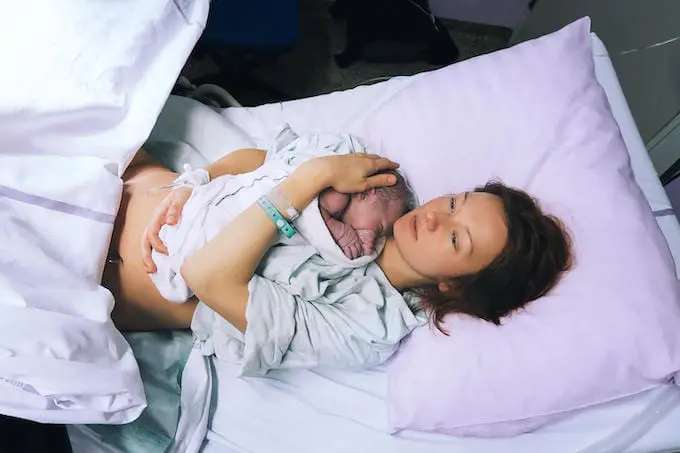
My son was delivered and placed on my chest.
I had sustained a third-degree tear and then began to haemorrhage.
My husband still remembers the amount of blood on the floor and the towels being used to clean it up. I remember crying as I was told I needed surgery. I had never had an operation before, and suddenly I was being wheeled away from the baby I had only just met.
Later, my husband was sent home and my epidural began to wear off.
Because it was Boxing Day, there was a long wait before a doctor could prescribe stronger pain relief. I was alone with a newborn, in significant pain and completely overwhelmed by what had just happened.
That night remains one of the loneliest memories of my life.
But in many ways, the birth was only the beginning.
I knew very early that something wasn’t right with my body. One night, while searching my symptoms online, I came across the word prolapse. My stomach dropped. It described the bulge I could feel between my legs.
Still, I was repeatedly reassured by the hospital that what I was experiencing was normal — even months after the birth.
Eventually, I trusted my instincts and sought another opinion.
A pelvic health physiotherapist diagnosed me with a three-compartment prolapse. My bladder, uterus and bowel were all prolapsing into my vagina.
I remember sitting there as she explained what that meant for my future, including being told that I should no longer lift my baby.
That was the point at which everything fell apart.
I had gone into motherhood expecting sleepless nights, feeding struggles and all the usual challenges of having a newborn. I had never imagined being told that my body had been permanently injured during his birth, or that I might not be able to physically mother him in the way I had expected.
Not long afterwards, I was admitted to St John of God Psychiatric Hospital in Burwood, Sydney.
I stayed for a month.
I wasn’t only trying to recover from becoming a mother. I was trying to understand what had happened to me, grieve the body and future I thought I would have, and somehow find a way forward.
Then Amy Dawes appeared in a Facebook support group in 2016. She became someone I could confide in, someone who would listen and truly hear me. She told me she was starting a charity to support women like us, and, to be honest, I didn’t really believe her at the time. Who just starts a charity? It sounded crazy. But ten years on, Amy was absolutely true to her word. She has tirelessly built Birth Trauma Australia from the ground up, supporting women just like me who have experienced birth trauma.
Birth Trauma Australia has been pivotal in my survival of that trauma. There were days I didn’t want to live. I felt completely alone, broken, and as though there was no hope for my future.
My conversations with Amy, and later my volunteer work with the charity, gave me hope. I met women who had experienced the same trauma as me, including women who were further along in their recovery and could show me that life could get better. And as time went on, I discovered that hope was real.
Once I began to heal, I felt compelled to pass that same hope on to women who weren’t as far along in their journey as I was. That “work” never really felt like work, and in many ways, helping other women became part of my own healing too.
I honestly don’t know where I would be without Birth Trauma Australia and Amy Dawes. I’m incredibly grateful to have played even a very small part in helping change the conversation around birth trauma, birth standards and recovery for future generations.